

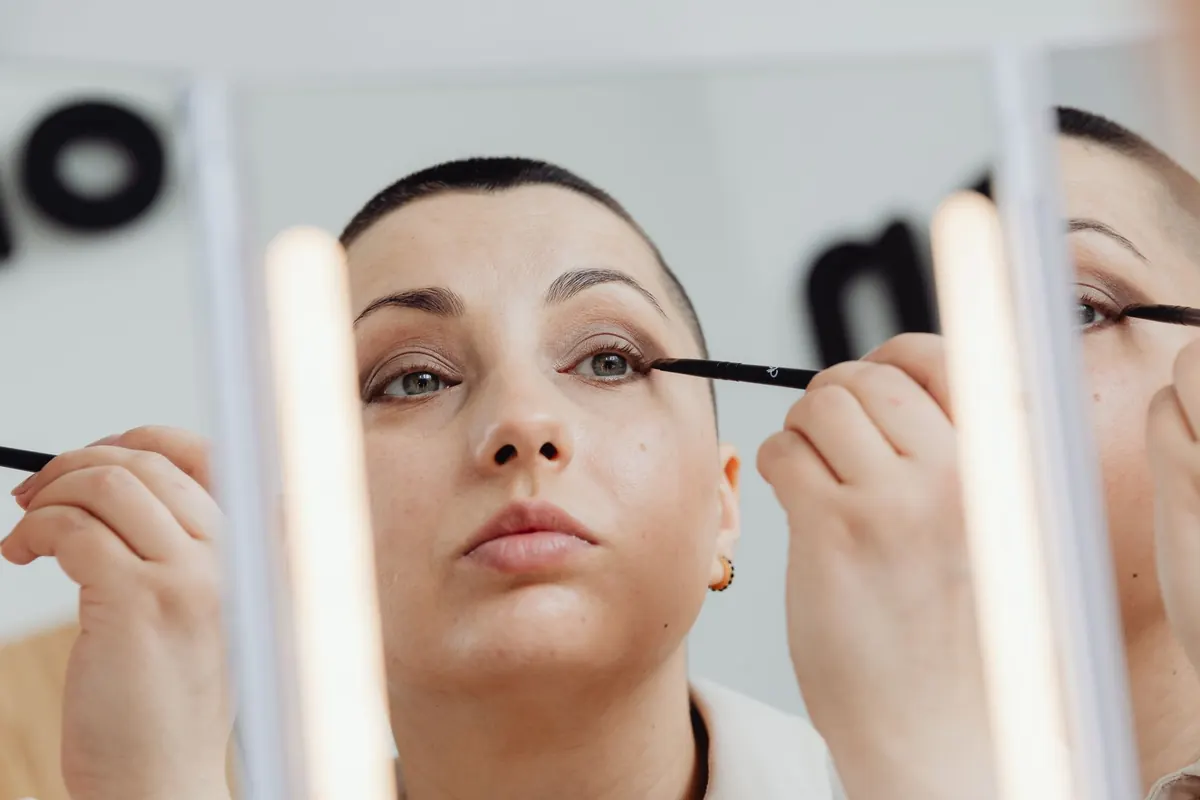
EXCERPT: A beginner-friendly guide to lilac eyeliner for mature eyes: how to choose the right shade, apply it without tugging, and keep soft purple definition in place all day
Most of us were taught that eyeliner means black. Then, somewhere in our forties, black started working against us — it looked harder than it used to, it made the whites of the eyes look tired, and it settled into every fine line around the lash line. Lilac eyeliner is the quiet fix. It gives you definition without a hard edge, and it flatters mature eyes in a way that very few other colours can.
This guide walks you through the whole thing: why lilac works on over-50 eyes, how to pick the right purple for your eye colour and skin tone, a step-by-step application you can do in five minutes, and how to keep it in place from morning coffee to evening.
Why Lilac Works So Well on Mature Eyes
Lilac sits on the cool side of purple, and purple is the direct opposite of yellow on the colour wheel. That matters more than it sounds. As skin ages, it tends to take on a slightly sallow, yellow-grey undertone around the eyes. A lilac line neutralises that dullness and makes the eye area look fresher and more awake — the same principle behind a purple-tinted concealer, but applied as eyeliner.
There are three other reasons lilac is a smart choice after 50:
- It is softer than black or deep brown. A thinner lash line with less contrast means less emphasis on crow's feet and crepiness.
- It reads as shadow, not colour. Because lilac is close to the natural shadow tone of the eye socket, the result looks like definition rather than makeup.
- It brightens instead of drains. Black liner can make thinning lashes look sparser; a light-reflecting lilac makes the lash line look fuller and denser.
In short, lilac is the colour that says polished rather than trying hard.
Choosing the Right Shade of Lilac
Not every lilac is the same, and the wrong one can look grey, chalky or dated. Use these guidelines as a starting point.
Match to your eye colour
- Blue or grey eyes: Choose a blue-leaning lilac — lavender, periwinkle, cool violet. This deepens the blue without competing with it.
- Green or hazel eyes: Go for a pink-leaning lilac — mauve, orchid, soft plum-lilac. Greens and pinks sit opposite each other, so the contrast makes green eyes look vivid.
- Brown or dark eyes: Step up the saturation. A richer violet, deep plum-lilac or soft eggplant has enough depth to register against dark lashes.
Match to your skin tone
Fair and light skin tones look best in sheer, muted lilacs and soft lavenders — anything too opaque can look stark. Medium and olive skin tones can carry cooler, more saturated purples. Deeper skin tones should skip pale pastels entirely and look for jewel-toned violets and plums, which show up beautifully without going ashy.
Consider the finish
Satin finishes are the safest choice for mature lids: they have a subtle sheen that catches light without highlighting texture. Matte is elegant but can look dry and flat on crepey skin. Shimmer and glitter, on the other hand, tend to migrate into fine lines and emphasise every bit of loose texture — so if you love a bit of sparkle, keep it to the outer third of the lash line rather than the whole eye.
If you only change one thing about your eye makeup after 50, change the colour of your eyeliner. A softer, lighter line does more for tired eyes than any concealer.
What to avoid
- Chalky, white-based pastels that turn grey on the lid
- Pencils so dry they drag and skip across the skin
- Large glitter particles near the lash line
- Sharp, angular graphic wings that fight a softening eye shape
Step-by-Step: Applying Lilac Eyeliner
You will need: a lilac eyeliner pencil (cream or gel formula), a matte lilac or lavender eyeshadow, a small angled brush, a pointed cotton bud, and a micellar-water cleanser. That is genuinely it.
- Prep the lid first. Apply a light eye cream, wait a minute, then blot away the excess. Any leftover oil will break down the pencil within an hour.
- Prime the lid. A thin layer of eye primer or a dab of concealer, set with a whisper of translucent powder, gives the pencil something to grip.
- Warm the pencil on the back of your hand. Two or three small strokes is enough. Tepid pencil glides; cold pencil tugs. Never press hard to compensate for a dry tip.
- Work in short dashes, not one long stroke. Start at the outer third of the lash line and dot your way inward. Small movements give you control and let you stop before the line gets too heavy.
- Join the dashes. With feather-light strokes, connect the dots, keeping the pencil nestled right at the base of the lashes.
- Soften the line. Run the tip of a small brush or smudger along the line in one direction. Edges that are slightly diffused are far more forgiving than a hard, drawn line.
- Go slightly wider at the outer corner. Extend the line up and out a fraction, following the direction of your lower lash line. Keep it to two or three millimetres — a short flick, not a wing.
- Set it with powder. Dip a small angled brush into matte lilac or lavender eyeshadow and press it over the pencil line. This is the single most effective step for all-day wear.
- Clean up and finish. Tidy the edges with a pointed cotton bud, then curl lashes and apply mascara — a soft brown-black rather than a harsh jet black.
A useful trick for hooded or slightly drooping lids: work with the eye open, looking straight into a mirror held at eye level. Drawing with the eye closed means the line disappears into the fold the moment you look up.
Making It Last All Day
- Layer cream and powder. Pencil first, powder second. This sandwich technique keeps colour from sliding into creases.
- Powder under the eye, not just on the lid. A light dusting beneath the lower lash line gives smudges nothing to cling to.
- Keep heavy eye cream for night. Rich formulas and long-wear eyeliner are not friends.
- Carry a pointed cotton bud. A quick swipe is the fastest way to fix a mid-afternoon smudge, and it takes ten seconds.
- Use a setting spray on a closed eye if you are going somewhere important — a light mist rather than a soak.
Troubleshooting: Three Common Problems
The line looks grey or ashy
You have probably chosen a lilac that is too white-based for your skin tone. Try one shade warmer or pinker, or a formula that is more sheer. Greyness is almost always a mismatch problem, not a technique problem.
The colour keeps creeping under the eye
This usually means the lid is too oily or the pencil is too creamy. Blot the lid, re-powder, and switch to a gel pencil with a longer wear claim. Applying a little powder over the finished line also helps.
Eyes water every time you line them
Avoid the inner waterline, which is the most sensitive area. Instead, tightline only the outer half, or skip the waterline entirely and let the powder layer do the work. Your eyes will stop watering within a few applications.
Three Lilac Looks Worth Trying
- The bare-lid line: Lilac pencil and powder on the upper lash line only, with clean, neutral lids. The shortest route to fresh eyes.
- The soft shadow blend: Draw a thicker lilac line, then smudge it upward into a wash of taupe or soft brown. It looks like a blended eyeshadow but took two minutes.
- The lower-lash pop: Keep the upper line in brown or plum, and run lilac along the outer half of the lower lash line. Subtle colour, maximum brightening.
The Five-Minute Version
If you only have five minutes, do this: prime the lid, warm the pencil, dash-and-join along the upper lash line, smudge gently, press powder lilac over the top, tidy with a bud, curl and mascara. Step out the door.
Lilac eyeliner is not a trend to be brave about — it is simply one of the most flattering, forgiving upgrades available to mature eyes. Start with a soft, muted purple, keep the line thin, and let the colour do the brightening for you.