

Most players spend hours comparing bonus percentages, deposit limits, and wagering requirements — and almost no time understanding the three numbers that actually determine whether they walk away up or down: RTP, variance, and house edge. Bookmakers and casinos are not charities. They are businesses built on statistical margins that operate over millions of hands and spins. If you understand those margins, you stop treating the casino floor as a mystery and start treating it as a pricing sheet. That shift is the difference between gambling as entertainment and gambling as confused frustration.
What RTP Actually Tells You (And What It Doesn't)
Return to Player, usually written as a percentage, is the theoretical amount of all wagered money a game pays back to players over an enormous sample. A slot with 96% RTP returns 96 units for every 100 units cycled through it. That sounds generous until you do the math: 4% of every dollar you push through the machine is, on average, gone.
Here is where players get tripped up. RTP is not a session statistic. You can sit at a 97% RTP slot for two hours and lose everything. You can sit at a 94% RTP slot for ten spins and triple your bankroll. RTP only converges at volumes nobody plays — millions of spins. Slot developers run these numbers over hundreds of millions of simulated spins during testing, and regulators like the Malta Gaming Authority and the UK Gambling Commission require published RTPs to be auditable. Those comparing choices often turn to สล็อตเว็บตรง.
Where RTP becomes genuinely useful is in choosing between similar games. If you are going to play video slots, a 96.5% RTP machine from a major provider like NetEnt, Play'n GO, or Pragmatic Play is a meaningfully better long-term deal than a 92% machine from an older cabinet. At a thousand spins with one dollar stakes, that 4.5% gap is roughly 45 dollars in expected value.
Variance Is Why Two Players Have Different Nights
Variance — sometimes called volatility — describes how a game distributes its payouts. Two slots can both have 96% RTP and feel completely different.
- Low variance: frequent small wins. Think classic three-reel fruit slots or low-stake blackjack. You can play a long session on a modest bankroll, but the ceiling is limited.
- Medium variance: balanced. Many modern five-reel video slots fall here. Bonuses trigger reasonably often and payouts are respectable.
- High variance: rare, huge wins. Megaways titles and progressive jackpot slots live here. Streaks of dead spins are normal — hundreds in a row can occur before a 2,000x hit.
This is the number players should match to their bankroll, not their mood. High-variance slots on a 50-dollar deposit are almost a guaranteed bust. The same game on a 500-dollar bankroll with 50-cent spins gives you the runway to actually reach the bonus round where the real money sits.
House Edge in Table Games: Where Skill Still Matters
Table games have the same math but expressed differently. The house edge is the built-in advantage the casino holds on every bet, and it varies dramatically depending on the bet.
Take blackjack, arguably the best game for a disciplined player. Basic strategy — a fixed chart of correct plays based on your hand and the dealer's upcard — drops the house edge to roughly 0.5%. Play badly, hitting on 16 when the dealer shows a 5, and that edge can climb past 2%. The difference is not luck. It is math.
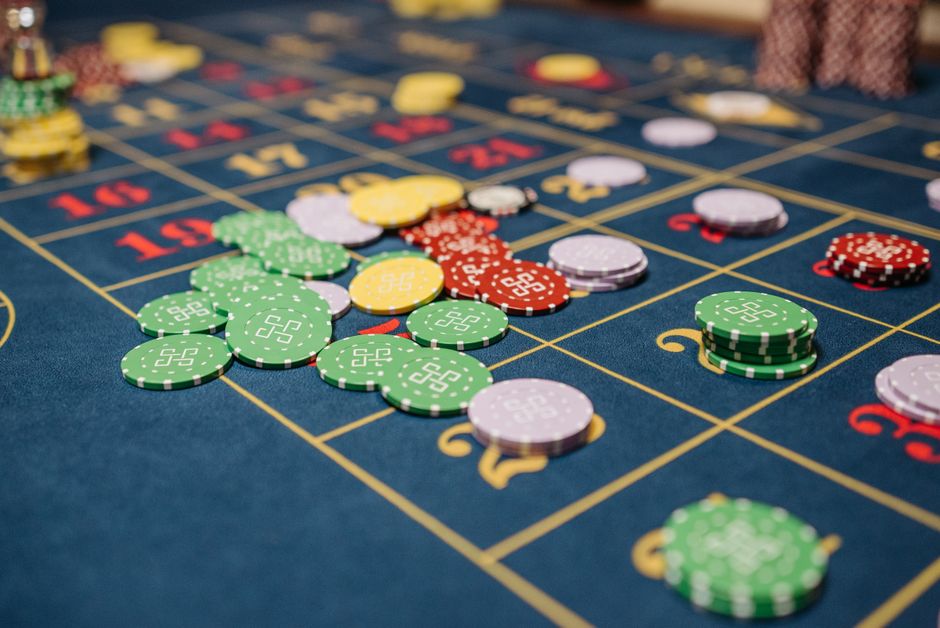
Roulette is famously split: European single-zero wheels carry a 2.7% house edge; American double-zero wheels carry 5.26%. Over a hundred spins at 10 dollars a spin, that gap is nearly 26 dollars in expected loss. Anyone playing American roulette online when a European table sits right next to it is voluntarily paying almost double the price.
Baccarat is even leaner. The banker bet has a house edge of around 1.06%, the player bet around 1.24%, and the tie bet — the one most players love — around 14.4%. Ties are the casino's best friend.
Poker Is Different — and That's the Point
Poker deserves its own category because you are not playing against the house. You are playing against other people, and the house takes a rake — typically 5% of the pot up to a cap, or a flat time charge in higher-stakes games. Your edge comes entirely from decision quality relative to opponents.
This is why poker bankroll management is not optional. A cash game player needs roughly 20 to 30 buy-ins to survive normal variance. A tournament player, where variance is far higher, needs 50 to 100 buy-ins. If you play 1-dollar/2-dollar no-limit hold'em with a 200-dollar roll, you are not playing poker — you are playing a coin flip with extra steps.
Poker also rewards specific, learnable skills that slots never will:
- Position — acting last in a hand gives you more information and more control.
- Pot odds — comparing the cost of a call to the size of the pot and your equity.
- Range thinking — reading opponents by the hands they plausibly hold, not guessing.
- Bankroll discipline — the unglamorous skill that separates winners from people who go broke.
Bonus Terms Are Where Casinos Reclaim the Edge
Welcome bonuses look like free money. Read the terms and most of them are not. A common offer — 100% up to 200 dollars with 40x wagering — means you must wager 8,000 dollars before withdrawing anything. If the bonus is attached to a 95% RTP slot, the expected loss on that wagering is 400 dollars. You started with a 200-dollar bonus, and the math is already underwater.
Do this instead:
- Check the game contribution table. Slots often count 100%, table games 10%, and some excluded entirely.
- Look for sticky-versus-non-sticky bonus rules. Non-sticky bonuses protect your real funds.
- Calculate the effective cost yourself: wagering requirement × house edge. Over 10% of the bonus and it is usually not worth the trap.
The Only Edge You Can Actually Build
Nobody beats the math over millions of spins. What you can beat is your own decisions. Choose high-RTP games over low ones. Match variance to your bankroll. Play European roulette, not American. Learn blackjack basic strategy and stick to it. Treat bonuses as mathematical puzzles rather than gifts. And if you play poker, treat bankroll management as a skill as important as your reads.
The people who last in iGaming — players and operators alike — are the ones who respect the numbers. The casino is not rigged against you. It is priced against you. Knowing the price is the first real edge you get.